
Table of Contents
If you’re still forecasting SEO traffic the way you did in 2022, your numbers are probably wrong. SEO forecasting used to be a fairly simple exercise: estimate where a keyword could rank, apply an average click-through rate for that position, and multiply by search volume. That formula is breaking down. Google’s AI Overviews now answer a huge share of queries directly on the results page, and that changes what a ranking is actually worth.
I’ve built SEO forecasts for real client sites, watched some predictions land almost exactly right, and watched others miss because I trusted rankings more than I trusted the data. This post walks through how I actually do SEO forecasting today, what’s changed because of AI, and the mistakes I see people make when they build their own traffic projections.
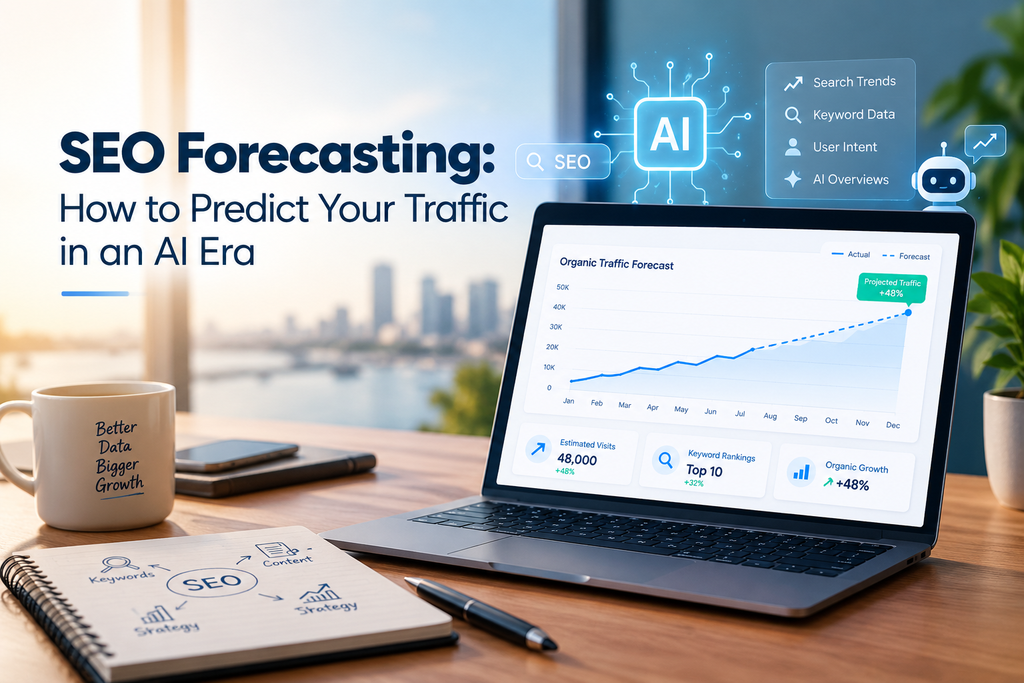
[Image suggestion: A line chart showing projected vs. actual organic traffic over 6 months. Alt text: “SEO forecasting chart comparing predicted and actual traffic growth.”]
What Is SEO Forecasting, and Why Is It Harder Now?
SEO forecasting is the process of predicting future organic traffic, rankings, or conversions based on current performance, keyword data, and planned SEO work. Marketers use it to set expectations, justify budgets, and measure whether a strategy is working.
The problem in 2026 is that a page can rank #1 and still lose traffic, because Google’s AI Overviews now appear on roughly half of all search queries, and when they do, organic click-through rates drop by an average of 58 to 61%. Independent research from Pew Research, Ahrefs, and Seer Interactive has each found meaningful CTR declines tied to AI Overviews, which means a forecast built purely on ranking position is now missing a critical variable. relevantaudiencegetairefs
That’s why any credible SEO forecasting model in 2026 needs to account for more than just where a page sits in search results.
My SEO Forecasting Process, Step by Step
Here’s the process I actually use when I forecast SEO traffic for a client:
- Pull baseline data. I start in Google Search Console, Google Analytics, and Google Keyword Planner to review current traffic, rankings, search volume, CTR, and conversions.
- Segment by intent and AI Overview exposure. I flag which target keywords are already triggering AI Overviews, since those need a different CTR assumption than keywords that don’t.
- Model ranking movement. I estimate how rankings could shift over 3–6 months based on planned content, technical fixes, and link building, plus seasonality patterns from historical data.
- Apply conservative and realistic CTR curves. Instead of one blended CTR-by-position table, I run two scenarios — conservative and realistic — so the client sees a range, not a single number they’ll hold me to.
- Forecast clicks, not just rankings. The final output is projected clicks, impressions, and conversions, not just an estimated position.
I typically project 3 to 6 months out. Anything longer than that gets unreliable fast, especially with how often Google changes the SERP layout.
[Image suggestion: A simple flowchart of the 5-step forecasting process. Alt text: “Step-by-step SEO forecasting model workflow.”]
A Real SEO Traffic Forecasting Example
A few years ago, I built an SEO forecast for a local digital marketing website targeting keywords like “freelance digital marketer in Kochi.” I projected traffic and ranking growth over 3–6 months using keyword research, competitive analysis, and the site’s current performance.
Overall, the results landed close to my forecast. But one keyword — “freelance digital marketer in Kochi” itself — moved faster than I predicted. It outperformed broader terms like “digital marketing services” because the intent behind it was so specific and location-based. Searchers using that phrase already knew what they wanted, which meant higher relevance, a stronger click-through rate, and faster ranking gains than a generic head term.
| Keyword | Forecasted Timeline | Actual Result |
| Freelance digital marketer in Kochi | 4–5 months to page 1 | Ranked in ~3 months |
| Digital marketing services (broad) | 3–4 months to page 1 | Took closer to 5 months |
The lesson: in any SEO forecasting model, specific, intent-rich, local keywords tend to be more predictable and faster-moving than broad, competitive ones.
How AI Overviews Changed My SEO Forecasting Model
Once AI Overviews started showing up consistently on informational queries, I stopped forecasting clicks the same way for every keyword. Now:
- I discount expected CTR for any keyword likely to trigger an AI Overview, especially at position one.
- I weight impressions and SERP feature presence more heavily, not just ranking position.
- I track actual clicks and conversions, not projected rankings, as the real measure of whether a forecast held up.
This matters because Ahrefs found that AI Overviews caused a 58% drop in click-through rate for the top-ranking search result, based on data gathered across 300,000 keywords. A forecast that ignores that shift will overstate expected traffic, sometimes significantly. medianama
The Biggest SEO Forecasting Mistake to Avoid
The mistake I see most often — from beginners and experienced marketers alike — is assuming that higher rankings automatically produce a proportional increase in traffic. That assumption used to hold up reasonably well. It doesn’t anymore.
If you’re building a forecast, don’t rely on rankings alone. Factor in:
- Click-through rate curves adjusted for AI Overviews and other SERP features
- Seasonality specific to your industry
- Search intent, not just search volume
- Historical CTR data from your own Search Console, not generic industry averages
SEO Forecasting Tools Worth Using
- Google Search Console — your most reliable source of real impressions, clicks, and CTR by query
- Google Keyword Planner — search volume and competition data
- Google Analytics — conversion tracking tied to organic traffic
- Ahrefs or Semrush — for competitive ranking and SERP feature tracking
[Video/embed suggestion: A short screen-recording walkthrough showing how to pull and filter Search Console data by query, embedded under the tools section.]
FAQs
How far out should an SEO forecast project?
Most of the time, 3 to 6 months is the sweet spot. Beyond that, algorithm changes and shifting SERP features make longer-range forecasts unreliable.
Do AI Overviews mean SEO forecasting is pointless now?
No, but it does mean forecasts need to build in lower CTR assumptions for AI Overview-triggering keywords rather than using pre-AI benchmarks.
What’s the single best thing to check before trusting a forecast?
Your own Google Search Console data. Compare impressions, clicks, CTR, and rankings for your top keywords against what your forecast predicted, and adjust from there.
Conclusion
SEO forecasting isn’t broken, but the old shortcuts are. Rankings alone no longer tell you how much traffic a keyword will actually deliver, especially with AI Overviews reshaping click behavior across so many search results. The forecasts that hold up in 2026 are the ones built on real Search Console data, intent-specific keyword analysis, and CTR assumptions that account for AI Overviews rather than ignoring them.
If you take one thing from this post, make it this: this week, pull your Google Search Console data and compare impressions, clicks, CTR, and rankings for your top keywords. Use that real performance data to sanity-check your next forecast, instead of relying on assumptions from a pre-AI search landscape.
As a Freelance Digital Marketer in Kochi, I help businesses build a strong online presence through effective digital marketing strategies. I provide services such as SEO, social media marketing, content marketing, and digital advertising to help businesses reach their target audience and improve online visibility. My goal is to create customized marketing strategies that attract potential customers, increase website traffic, and support business growth. Whether you are a startup, small business, or established brand, I offer personalized digital marketing solutions tailored to your business goals.